

Paper Wasp
go.ncsu.edu/readext?563191
en Español / em Português
El inglés es el idioma de control de esta página. En la medida en que haya algún conflicto entre la traducción al inglés y la traducción, el inglés prevalece.
Al hacer clic en el enlace de traducción se activa un servicio de traducción gratuito para convertir la página al español. Al igual que con cualquier traducción por Internet, la conversión no es sensible al contexto y puede que no traduzca el texto en su significado original. NC State Extension no garantiza la exactitud del texto traducido. Por favor, tenga en cuenta que algunas aplicaciones y/o servicios pueden no funcionar como se espera cuando se traducen.
Português
Inglês é o idioma de controle desta página. Na medida que haja algum conflito entre o texto original em Inglês e a tradução, o Inglês prevalece.
Ao clicar no link de tradução, um serviço gratuito de tradução será ativado para converter a página para o Português. Como em qualquer tradução pela internet, a conversão não é sensivel ao contexto e pode não ocorrer a tradução para o significado orginal. O serviço de Extensão da Carolina do Norte (NC State Extension) não garante a exatidão do texto traduzido. Por favor, observe que algumas funções ou serviços podem não funcionar como esperado após a tradução.
English
English is the controlling language of this page. To the extent there is any conflict between the English text and the translation, English controls.
Clicking on the translation link activates a free translation service to convert the page to Spanish. As with any Internet translation, the conversion is not context-sensitive and may not translate the text to its original meaning. NC State Extension does not guarantee the accuracy of the translated text. Please note that some applications and/or services may not function as expected when translated.
Collapse ▲- Common Name: Paper Wasp
- General Category: Beneficial Predator
- Taxonomic Classification: Hymenoptera: Vespidae
- Scientific Name: Many species
Description
These predatory wasps have a social structure similar to honeybees, with a queen and workers. After a queen has started a paper nest in the spring, the workers take over and hunt continuously to feed larvae developing in the nest. They are voracious predators of caterpillars and other insects, but will act as scavengers as well. When a worker finds a caterpillar, they will kill it, then chew it up and roll it into a ball for easier transport back to the nest. Hover fly adults often mimic the color patterns of these wasps (see comparison), presumably to gain protection from their own predators. These wasps are capable of stinging multiple times, primarily in defense of their nests.
Identification
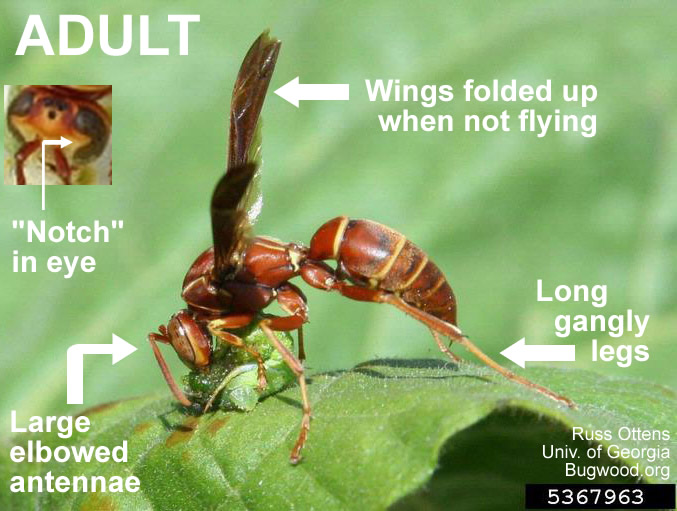
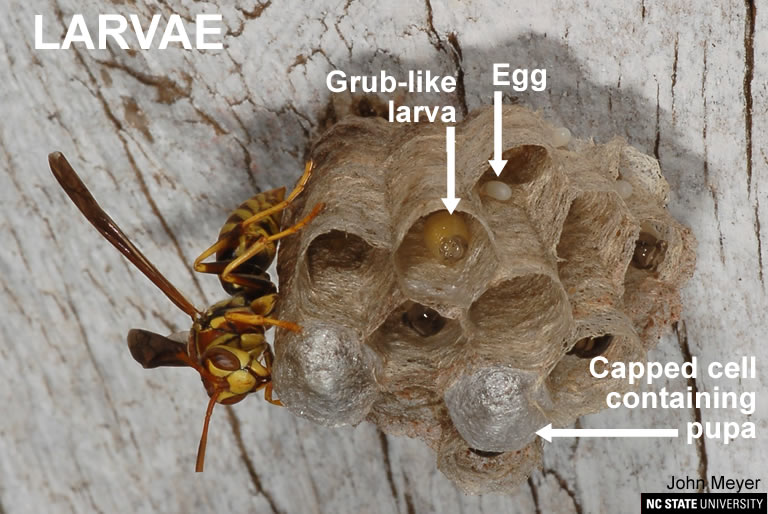
Review the images for tips on how to identify these predators.
Adults
Unlike flies, bees, and many other wasps, these fold their 4 wings up longitudinally when not flying (see comparison). They also have large, “elbowed” antennae, “notched” eyes, and long, gangly legs.
Larvae
The grub-like larvae live inside individual cells of the paper nest, and are cared for initially by the queen, and later by her workers. After larvae have fully grown, they will pupate inside of a capped cell.
Value in Pest Management
Paper wasps are very valuable natural controls and contribute to population regulation of caterpillars in particular, but likely other insects as well. Conservation biological control efforts have in the past focused on building and developing wooden nest boxes around tobacco fields to increase numbers of wasps and reduce caterpillar numbers in the adjacent crop. They are not sold commercially.
Origin and Distribution
Native, throughout eastern North America.