

Chinese Mantid
go.ncsu.edu/readext?563186
en Español / em Português
El inglés es el idioma de control de esta página. En la medida en que haya algún conflicto entre la traducción al inglés y la traducción, el inglés prevalece.
Al hacer clic en el enlace de traducción se activa un servicio de traducción gratuito para convertir la página al español. Al igual que con cualquier traducción por Internet, la conversión no es sensible al contexto y puede que no traduzca el texto en su significado original. NC State Extension no garantiza la exactitud del texto traducido. Por favor, tenga en cuenta que algunas aplicaciones y/o servicios pueden no funcionar como se espera cuando se traducen.
Português
Inglês é o idioma de controle desta página. Na medida que haja algum conflito entre o texto original em Inglês e a tradução, o Inglês prevalece.
Ao clicar no link de tradução, um serviço gratuito de tradução será ativado para converter a página para o Português. Como em qualquer tradução pela internet, a conversão não é sensivel ao contexto e pode não ocorrer a tradução para o significado orginal. O serviço de Extensão da Carolina do Norte (NC State Extension) não garante a exatidão do texto traduzido. Por favor, observe que algumas funções ou serviços podem não funcionar como esperado após a tradução.
English
English is the controlling language of this page. To the extent there is any conflict between the English text and the translation, English controls.
Clicking on the translation link activates a free translation service to convert the page to Spanish. As with any Internet translation, the conversion is not context-sensitive and may not translate the text to its original meaning. NC State Extension does not guarantee the accuracy of the translated text. Please note that some applications and/or services may not function as expected when translated.
Collapse ▲- Common Name: Chinese Mantid
- General Category: Harmful Predator
- Taxonomic Classification: Mantodea: Mantidae
- Scientific Name: Tenodera aridifolia
Description
Mantids are captivating, almost iconic insects that are easily recognized by their specialized (raptorial) front legs which they use to grasp prey. The Chinese mantid is a common non-native species that is considered by some to be an exotic, invasive species. It has been sold commercially for decades for pest management, but appears to have little value in this regard. The two most similar, commonly encountered, mantids in the eastern U.S. are the native Carolina mantid and the non-native European mantid, that can both be easily distinguished from the Chinese mantid.
Identification
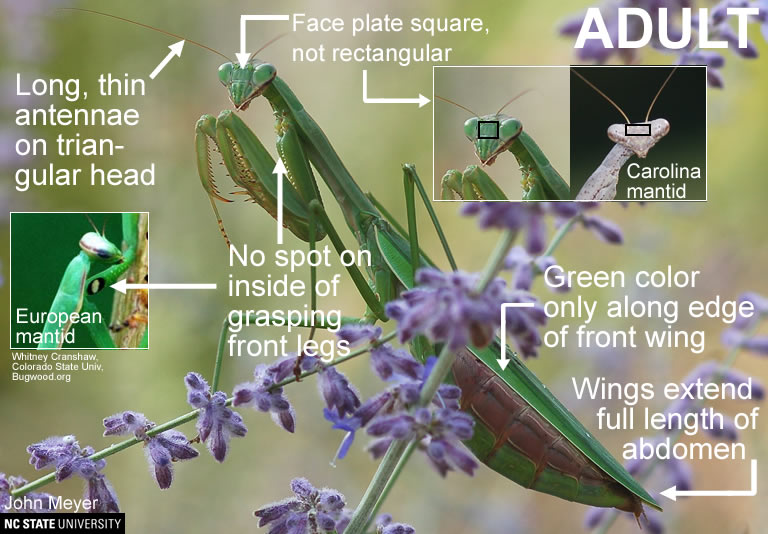
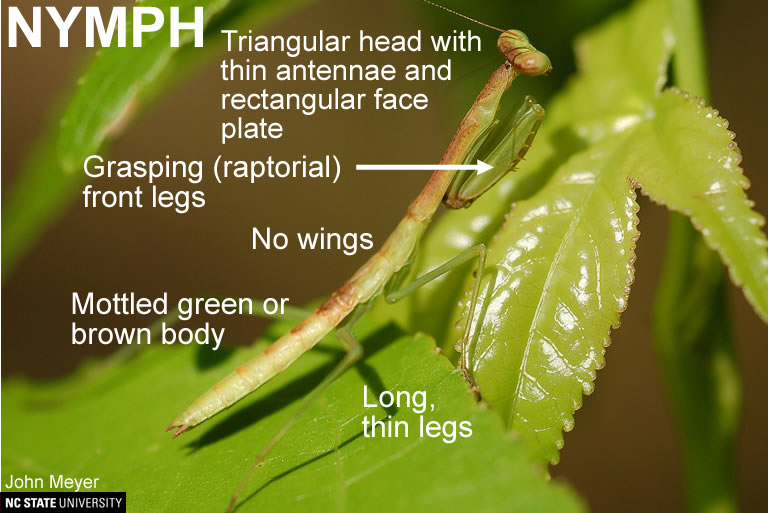
Review the images for tips on how to identify these predators.
Adults
All mantids are easily distinguished by their specialized front legs which they use to grasp prey. Adult Chinese mantids have a face plate that is more square than rectangular (as in Carolina and European mantids), their wings extend the full length of their abdomen (shorter in Carolina), the wings are green only on the front edge of the forewings (as opposed to all green in European), and they do not have a large spot on the inside of the front legs near the body (as in European) . Chinese mantids are also larger (3 to 4+ inches compared to 2 inches or less for Carolina mantids and 2 to 2.5 inches for European mantids).
Nymphs
Again, the face plate is close to square, and they do not have a leg spot.
Value in Pest Management
Chinese mantids have no demonstrated value in pest management. This is because they are ambush predators and will attack anything within reach that they can subdue, but do not actively seek out insect pests. They are non-selective and have been documented attacking beneficial insects, hummingbirds, snakes, and even small mammals. In this regard, they can be considered pests. They are sold commercially (see BIRC online Directory).
Origin and Distribution
Non-Native. Most commonly found in southern and southwestern United States.
Discover Life – Tenodera aridifolia